
Bitcoin
Price Chart
Market Cap
24h Volume
7d Change
Circulating Supply
24h High
24h Low
Price Change 24h
Price Statistics
Supply & Market Info
External Resources
About Bitcoin
Bitcoin is a decentralized digital currency that enables peer-to-peer transactions without the need for intermediaries like banks or governments. Created in 2009 by the pseudonymous Satoshi Nakamoto, Bitcoin introduced blockchain technology to the world and sparked the cryptocurrency revolution.
Unlike traditional currencies, Bitcoin operates on a distributed ledger called the blockchain, where all transactions are recorded and verified by a network of computers (nodes) around the world. This makes Bitcoin transparent, secure, and resistant to censorship.
Key Features
Decentralization
No single entity controls Bitcoin. The network is maintained by thousands of nodes worldwide, making it nearly impossible to shut down or manipulate.
Limited Supply
Bitcoin has a maximum supply of 21 million coins, with approximately 19.6 million already in circulation. This scarcity is built into the protocol and cannot be changed, making Bitcoin deflationary by design.
Security
Bitcoin's blockchain uses proof-of-work consensus and cryptographic hashing to secure transactions. The network has never been successfully hacked since its inception.
Transparency
All Bitcoin transactions are recorded on a public ledger that anyone can view. While addresses are pseudonymous, the transaction history is completely transparent.
Use Cases & Adoption
Store of Value
Often called "digital gold," Bitcoin is increasingly viewed as a hedge against inflation and a long-term store of value. Institutional investors, corporations, and even countries have added Bitcoin to their balance sheets.
Payment Method
Thousands of merchants worldwide accept Bitcoin as payment, from small online retailers to major companies like Microsoft, AT&T, and Overstock. El Salvador became the first country to adopt Bitcoin as legal tender in 2021.
Remittances
Bitcoin enables fast, low-cost international money transfers, particularly beneficial for people in countries with unstable currencies or limited access to banking services.
Investment Asset
Bitcoin is traded on major exchanges worldwide and has become a significant asset class. The launch of Bitcoin ETFs in the United States has made it accessible to traditional investors through retirement accounts.
DeFi and Smart Contracts
While Bitcoin's native smart contract capabilities are limited, Layer 2 solutions like the Lightning Network and sidechains like Stacks are bringing DeFi functionality to Bitcoin.
Historical Milestones
2009: Genesis Block
On January 3, 2009, Satoshi Nakamoto mined the first Bitcoin block, known as the Genesis Block, marking the birth of cryptocurrency.
2010: First Real-World Transaction
On May 22, 2010, programmer Laszlo Hanyecz paid 10,000 BTC for two pizzas, establishing Bitcoin's first real-world value. This day is now celebrated as "Bitcoin Pizza Day."
2017: First Major Bull Run
Bitcoin reached nearly $20,000 in December 2017, capturing mainstream attention and triggering a wave of new cryptocurrency projects.
2020: Institutional Adoption Begins
Major companies like MicroStrategy and Tesla began adding Bitcoin to their treasury reserves, signaling growing institutional acceptance.
2021: All-Time High
Bitcoin reached its all-time high of $69,045 on November 10, 2021, driven by institutional adoption and retail enthusiasm.
2024: Bitcoin ETF Approval
The U.S. Securities and Exchange Commission approved spot Bitcoin ETFs, opening the doors for mainstream investment and bringing billions in new capital to the market.
How Bitcoin Works
Mining
Bitcoin is created through a process called mining, where specialized computers solve complex mathematical problems to validate transactions and secure the network. Miners are rewarded with newly created Bitcoin and transaction fees.
Halving Events
Approximately every four years, the Bitcoin mining reward is cut in half in an event called the "halving." This programmatic reduction in new supply is designed to control inflation. The next halving is expected in April 2024.
Transactions
When you send Bitcoin, the transaction is broadcast to the network, verified by miners, and added to a block on the blockchain. Transactions typically confirm within 10-60 minutes depending on network congestion and fees paid.
Wallets
Bitcoin is stored in digital wallets, which can be software-based (mobile apps, desktop programs) or hardware devices. Your wallet holds private keys that prove ownership of your Bitcoin.
Bitcoin vs. Other Cryptocurrencies
Bitcoin vs. Ethereum
While Bitcoin focuses on being a store of value and payment system, Ethereum is designed as a platform for smart contracts and decentralized applications. Bitcoin is more established and has greater institutional adoption, while Ethereum offers more programmability.
Bitcoin vs. Altcoins
Bitcoin has the largest market capitalization, longest track record, and strongest network security. Most altcoins offer specific features like faster transactions, privacy, or smart contract capabilities, but none have matched Bitcoin's brand recognition or adoption as "digital gold."
Market Dominance
Bitcoin typically maintains 40-50% of the total cryptocurrency market capitalization, a metric known as "Bitcoin dominance." When Bitcoin dominance rises, it often signals a flight to safety within the crypto market.
Investment Considerations
Volatility
Bitcoin is known for significant price swings. While it has delivered exceptional returns over the long term, short-term volatility can be extreme. Prices can fluctuate 10-20% or more in a single day.
Regulatory Environment
Bitcoin's regulatory status varies by country. The United States treats it as property for tax purposes, requiring capital gains reporting. Some countries have embraced Bitcoin, while others have restricted or banned its use.
Security Risks
While the Bitcoin network itself is highly secure, individual holders face risks from exchange hacks, phishing attacks, and lost private keys. Proper security practices, including hardware wallets and secure backup procedures, are essential.
Long-term Potential
Proponents argue Bitcoin could eventually reach valuations of $100,000 to $1 million per coin as adoption increases and its role as "digital gold" solidifies. Critics point to regulatory risks, environmental concerns, and competition from other cryptocurrencies.
How to Buy Bitcoin
Cryptocurrency Exchanges
The most common way to buy Bitcoin is through exchanges like Coinbase, Kraken, Binance, or Gemini. These platforms allow you to buy Bitcoin with traditional currency and store it in an exchange wallet.
Bitcoin ATMs
Physical Bitcoin ATMs allow you to purchase Bitcoin with cash. These machines are available in many cities worldwide but typically charge higher fees than online exchanges.
Peer-to-Peer Platforms
Services like LocalBitcoins and Paxful connect buyers and sellers directly, allowing for various payment methods including bank transfers, PayPal, and cash.
Bitcoin ETFs
In the United States and other countries, you can now buy Bitcoin exposure through exchange-traded funds in your regular brokerage account, making it accessible through retirement accounts like IRAs.
Network Statistics
Hash Rate
Bitcoin's hash rate—a measure of the computational power securing the network—has grown exponentially since inception, currently sitting at over 500 exahashes per second (EH/s), making it the most secure blockchain in existence.
Energy Consumption
Bitcoin mining consumes significant energy, though estimates vary widely. The network increasingly uses renewable energy sources, with some estimates suggesting over 50% of mining uses sustainable energy.
Active Addresses
Millions of unique Bitcoin addresses are active daily, demonstrating ongoing usage and adoption of the network.
Lightning Network
Bitcoin's Layer 2 scaling solution, the Lightning Network, has grown to over 5,000 BTC capacity with thousands of nodes, enabling near-instant, low-fee Bitcoin transactions.
Frequently Asked Questions
Is Bitcoin a good investment?
Bitcoin has delivered exceptional returns since its creation, but past performance doesn't guarantee future results. It remains a high-risk, high-reward investment suitable primarily for those who understand the technology and can afford to lose their investment. Most financial advisors recommend allocating only a small percentage of your portfolio to Bitcoin if you choose to invest.
How many Bitcoins are left to mine?
Approximately 1.4 million Bitcoins remain to be mined out of the 21 million total supply. At the current emission rate, the last Bitcoin won't be mined until approximately the year 2140, though the vast majority will be mined by 2030.
Can Bitcoin be hacked?
The Bitcoin network itself has never been successfully hacked. Its proof-of-work consensus mechanism and massive hash rate make a 51% attack economically impractical. However, individual exchanges, wallets, and users can be vulnerable to hacks, which is why proper security practices are essential.
Is Bitcoin legal?
Bitcoin is legal in most countries, including the United States, Canada, the European Union, and Japan. However, some countries have restricted or banned its use. The legal status continues to evolve as governments develop regulatory frameworks for cryptocurrencies.
What determines Bitcoin's price?
Bitcoin's price is determined by supply and demand across global exchanges. Factors influencing price include: adoption rates, regulatory news, macroeconomic conditions, institutional investment, mining costs, halving events, and overall market sentiment toward cryptocurrencies.
Can Bitcoin reach $100,000 or higher?
Price predictions vary widely among analysts. Bulls argue that growing institutional adoption, limited supply, and Bitcoin's role as "digital gold" could drive prices to $100,000 or higher. Bears cite regulatory risks, environmental concerns, and competition from other assets. Ultimately, Bitcoin's future price remains highly speculative.
How is Bitcoin different from traditional money?
Unlike traditional fiat currencies controlled by central banks, Bitcoin is decentralized, has a fixed supply cap, operates 24/7 globally, and can be transferred without intermediaries. However, it's more volatile, not widely accepted as payment, and lacks government backing or insurance protections.
What happens when all 21 million Bitcoins are mined?
When all Bitcoins are mined, miners will be compensated solely through transaction fees rather than block rewards. This is expected around the year 2140. The network should remain secure as long as transaction fees provide sufficient incentive for miners to continue operating.
Additional Resources
Official Bitcoin Resources
- Bitcoin.org - Original Bitcoin resource site
- Bitcoin White Paper - Satoshi Nakamoto's original vision document
- BitcoinTalk.org - Long-running Bitcoin discussion forum
Developer Resources
- Bitcoin Core - Official Bitcoin client software
- Bitcoin Improvement Proposals (BIPs) - Protocol upgrade proposals
- Lightning Network - Layer 2 scaling solution
Educational Resources
- "The Bitcoin Standard" by Saifedean Ammous - Economic analysis of Bitcoin
- "Mastering Bitcoin" by Andreas Antonopoulos - Technical deep dive
- Bitcoin podcasts: What Bitcoin Did, The Bitcoin Standard Podcast
Latest News
Bitcoin Hovers at $69K as Iran Ceasefire Hopes Fade
Bitcoin gave back Monday's gains on Tuesday morning, falling to around $69,169 as optimism over a US-Iran ceasefire quickly evaporated and President D...
Bitcoin's Worst Q1 Since 2018: The 23% Drop That Rewrote the Record Books
As the first quarter of 2026 closes today, Bitcoin is cementing one of the most difficult starts in its 17-year history. With a quarterly loss approac...
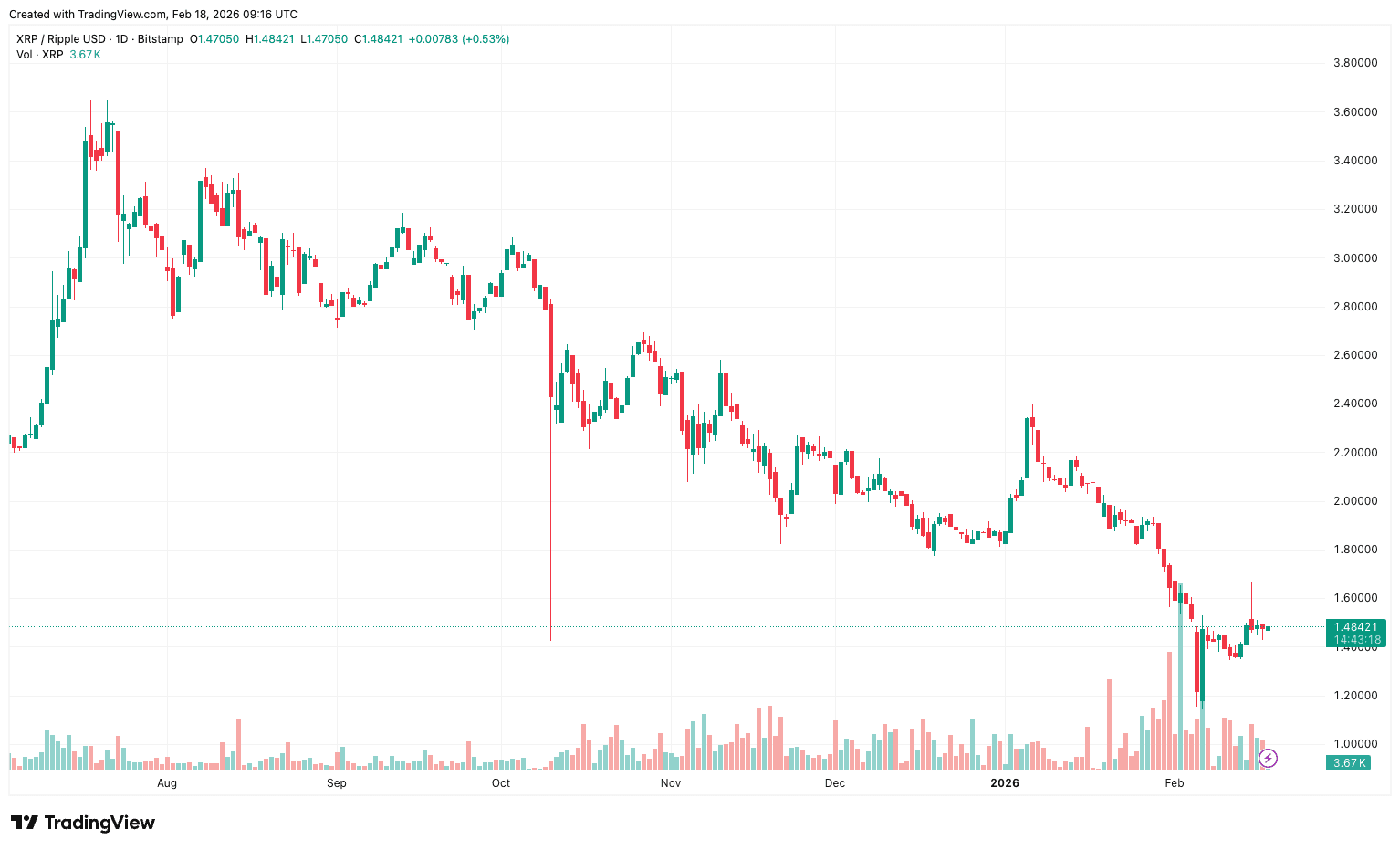
The Wall Street Forecast That Shocked XRP Holders: When Confidence Collapses by 65% Overnight
On a Thursday afternoon in mid-February, one of the world's largest banks did something that sent a chill through the XRP community. Standard Chartere...
BlackRock's Bitcoin Warning: It's Not the ETFs. It's the Leverage.
During one of Bitcoin's worst weeks in years, the man who runs the world's biggest Bitcoin ETF had something surprising to say. It wasn't a price targ...
Disclaimer: This information is for informational purposes only and does not constitute financial advice. Cryptocurrency investments carry risk. Always do your own research. See our Financial Disclaimer for details.