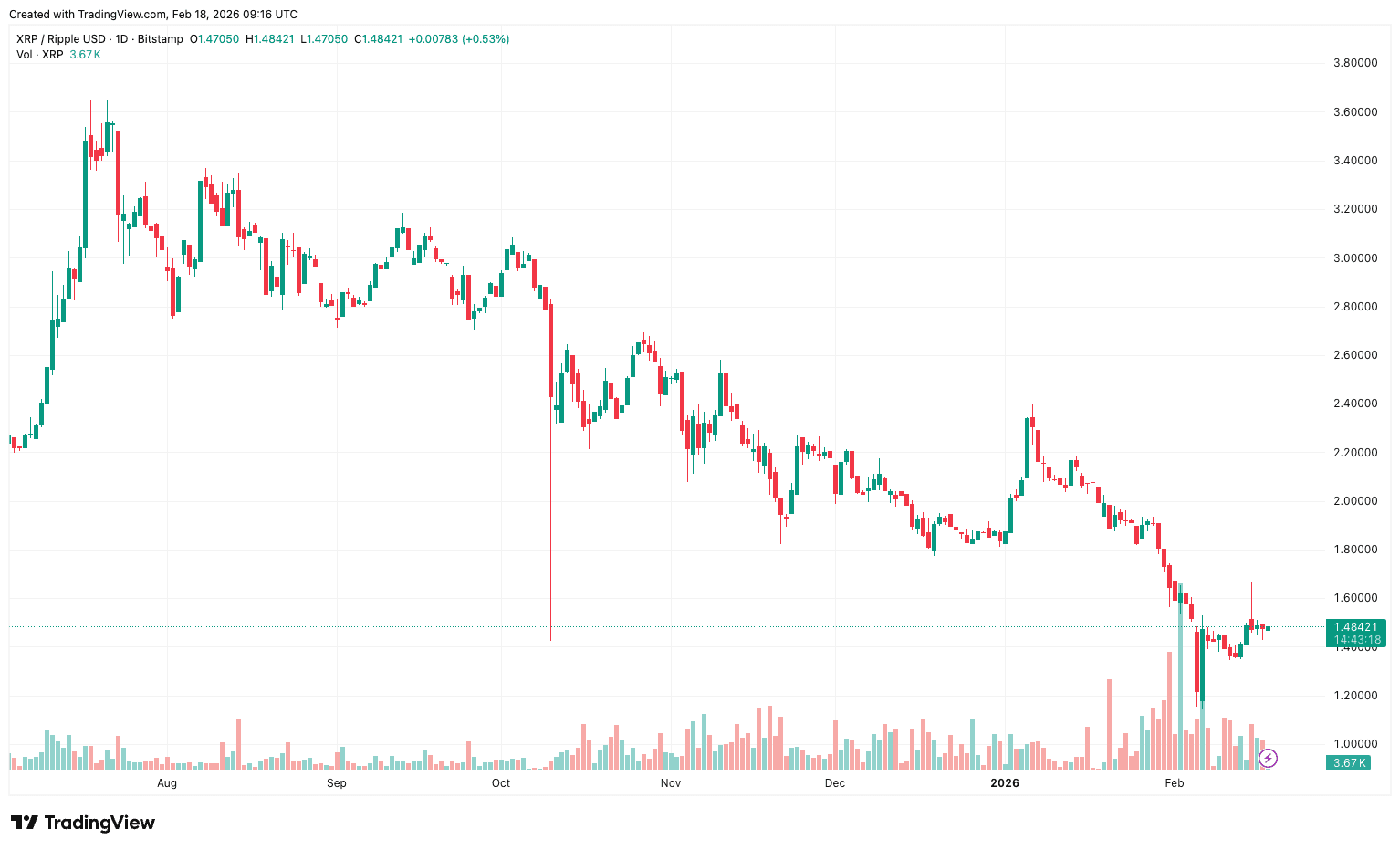
The Wall Street Forecast That Shocked XRP Holders: When Confidence Collapses by 65% Overnight

On a Thursday afternoon in mid-February, one of the world's largest banks did something that sent a chill through the XRP community. Standard Chartered—a firm with operations across seventy markets and a digital assets research team led by Geoffrey Kendrick, one of crypto's most closely watched institutional voices—took a red pen to its 2026 price forecasts and slashed them with a severity that bordered on capitulation.
The XRP target fell from $8.00 to $2.80. A 65% reduction. Not a trim. Not a modest revision. A statement.
Bitcoin's forecast dropped from $150,000 to $100,000. Ethereum went from $7,500 to $4,000. Solana fell from $250 to $135. Across the board, Standard Chartered was telling the market: we got this wrong, and the pain might not be over.
But here is the part that makes this story more than just another Wall Street retreat. On the same week that Standard Chartered was reducing its XRP forecast by nearly two-thirds, XRP was leading institutional inflows among major digital assets. While Bitcoin saw $133 million in outflows and Ethereum lost $85.1 million, XRP attracted $33.4 million in fresh institutional capital, according to CoinShares data. Goldman Sachs had just disclosed $153 million in XRP ETF exposure in its Q4 filing. Grayscale reported that XRP was the second-most discussed crypto asset among its institutional clients, behind only Bitcoin.
The forecast said one thing. The money said another. That divergence is the story.
What Actually Changed in Three Months
In December 2025, Standard Chartered was bullish. The bank had issued an $8.00 year-end 2026 target for XRP, built on the premise that institutional demand through newly launched XRP ETFs would drive sustained adoption. The ETF thesis looked solid at the time. XRP spot ETFs had launched in early January 2026, and by January 14, assets under management had grown to nearly $1.6 billion—a faster initial uptake than many analysts had expected.
Fast forward to February 13, and Kendrick's tone had shifted entirely. In a research note to clients, he described recent price action as "challenging, to say the least," and warned that further near-term declines were likely. The revised $2.80 target represented not just a lower number, but a different thesis entirely. Where the December forecast assumed ETF momentum would sustain price appreciation, the February downgrade acknowledged what the data was showing: ETF fatigue had set in.
By February 13, XRP ETF assets had fallen to just above $1 billion—a 40% decline from the January peak in less than five weeks. That is not normal volatility. That is a structural shift in how capital is behaving. The inflows that had driven early optimism were reversing, and the market was repricing risk accordingly.
But Standard Chartered did not stop at XRP. The bank revised its entire crypto forecast framework, cutting targets across the asset class in what Kendrick framed as a response to weaker risk appetite, persistent ETF outflows, and a lack of conviction among institutional allocators. Bitcoin's $150,000 forecast—already a second downgrade from an earlier $200,000 projection—was reduced again to $100,000. Ethereum's $7,500 target was cut nearly in half to $4,000. Solana, which had been forecast to reach $250, was now expected to close the year at $135.
The scale of these cuts suggests this was not a minor recalibration. This was Standard Chartered signaling that the post-ETF rally it had anticipated was not materializing, and that the macro headwinds facing digital assets were stronger and more persistent than the bank had previously modeled.
The Paradox of Capital Flows
Here is where the story becomes harder to read in a straight line.
While Standard Chartered was downgrading its XRP forecast by 65%, the most recent CoinShares weekly report showed XRP leading institutional inflows. In the week ending February 14, XRP attracted $33.4 million in net inflows—more than any other major digital asset. Bitcoin, by contrast, saw $133 million leave investment products. Ethereum lost $85.1 million. The gap was not small.
This was not an isolated week. XRP had also led inflows the prior week, with $63.1 million recorded. Over the course of February, as the broader crypto market was hemorrhaging capital—$3.74 billion in monthly redemptions across digital asset investment products through four consecutive weeks of outflows—XRP was one of the few major tokens showing sustained institutional demand.
The divergence becomes even more pronounced when you look at who was buying. Goldman Sachs disclosed in its Q4 2025 Form 13F filing that it held approximately $153 million in XRP ETF exposure, spread across Bitwise, Franklin, Grayscale, and 21Shares products. That figure represented roughly 14% of the cumulative net inflows into XRP ETFs over the prior year, according to data compiled by market analysts tracking institutional filings.
Goldman's positioning was not speculative retail positioning. This was Goldman Sachs—a firm managing $3.6 trillion in assets under supervision—allocating real capital to a regulated XRP investment vehicle. Bank of America and Jane Street Group also held positions in XRP ETFs, though the exact size of their exposures was not publicly detailed in the same granular way. The institutional footprint was real, measurable, and growing.
Grayscale's research team added another data point. In client discussions throughout February, XRP was the second-most actively discussed digital asset behind Bitcoin. That is not a metric you see when institutional interest is collapsing. That is a metric consistent with active evaluation, portfolio construction, and ongoing allocation decisions.
So how do you square this? How does a forecast get cut by 65% during the same period that institutional capital is flowing in and major Wall Street firms are disclosing meaningful XRP exposure?
The answer lies in understanding what the forecast measures versus what the flows represent. Standard Chartered's target is a price projection—a view on where XRP will trade at year-end based on supply, demand, macro conditions, and sentiment. The institutional flows, by contrast, are a measure of where capital is rotating within the crypto asset class. Those two things can move in opposite directions when investors are reallocating rather than adding net new exposure.
What the data suggests is that institutions are not abandoning crypto. They are being selective. They are pulling capital out of Bitcoin and Ethereum—assets that have underperformed expectations and face significant technical resistance—and rotating some of that capital into XRP, which has regulatory clarity, institutional infrastructure, and a lower valuation relative to its 2025 highs. That rotation can create positive flows for XRP even in a market where overall sentiment is deteriorating.
It also suggests that the ETF outflows Standard Chartered cited as a reason for the downgrade may not be telling the full story. Total XRP ETF assets fell from $1.6 billion to $1 billion, yes. But that $600 million decline includes both redemptions and mark-to-market losses from XRP's price falling. The net redemption number—the actual capital leaving XRP ETFs—was smaller. And against that backdrop, the $33 million weekly inflow from institutions suggests that while some holders exited, others were stepping in at lower prices.
The paradox, in other words, is not a paradox. It is a market in transition, where different participants are responding to different signals at different speeds.
Why Near-Term Targets Fell While Long-Term Conviction Rose
There is another wrinkle in Standard Chartered's revised forecast that deserves attention. While the bank slashed its 2026 and 2027 XRP targets—$2.80 for year-end 2026, down from $8.00, and $7.00 for 2027, down from $10.40—it actually increased its longer-term projections. The 2028 target was raised to $12.60, and the 2030 forecast was kept at $27.
That is an unusual pattern. Downgrades typically cascade across time horizons. If you are less confident about near-term performance, you are usually less confident about long-term performance as well. The fact that Standard Chartered cut near-term targets while raising medium-term ones suggests the bank is making a specific call about timing, not about XRP's fundamental value proposition.
Kendrick's note hinted at the reasoning. He indicated that XRP and Ethereum should keep pace with each other over the medium term, and that both assets stand to benefit structurally from the expansion of stablecoin issuance and the tokenization of real-world assets. Those are multi-year trends. They do not move quarterly price targets. But they do underpin longer-term adoption scenarios.
What the revised forecast structure implies is that Standard Chartered expects a prolonged period of range-bound trading and weak sentiment through 2026, followed by a shift in market structure as regulatory frameworks solidify and institutional use cases for XRP mature. The Clarity Act—legislation currently under consideration in the U.S. Senate that would transfer more crypto oversight to the CFTC and provide clearer rules for digital asset classification—was specifically cited by Standard Chartered as a potential catalyst for sentiment improvement in the latter half of 2026.
If that legislation passes, and if the CFTC's approach to XRP is more favorable than the SEC's posture has been, then the regulatory overhang that has weighed on institutional adoption could lift. That would create conditions for the kind of re-rating Standard Chartered is modeling for 2028 and beyond. But until that clarity arrives, the bank appears to be pricing in caution.
The long-term target increases also align with what Ripple has been signaling about its own roadmap. The company's president, Monica Long, described 2026 as the year of "institutional adoption at scale," with production-level deployments of XRP-based payment infrastructure expected to go live. Token Escrow XLS-85—a protocol upgrade that allows compliant, controlled access to on-chain liquidity—went live on the XRP mainnet in February. Permissioned domains are now active on XRPL, and permissioned trading on the built-in decentralized exchange is slated to launch imminently.
These are not speculative features. These are the building blocks of institutional-grade infrastructure—tools that allow banks, payment processors, and corporate treasurers to move value on-chain without sacrificing regulatory compliance or operational control. If those tools gain traction, they create demand for XRP that is structurally different from the speculative demand that drove prices in 2017 or 2021. That structural demand is what underpins Standard Chartered's $27 long-term target, even as the bank expects near-term price action to remain weak.
What the Broader Cuts to Bitcoin, Ethereum, and Solana Signal
Standard Chartered's XRP downgrade did not happen in isolation. The bank cut forecasts across the entire crypto asset class, and the rationale Kendrick offered was consistent across all four major tokens: ETF outflows, weaker risk appetite, and macroeconomic headwinds.
Bitcoin's revised $100,000 target was the second downgrade in under three months. The bank had initially forecast $200,000 for year-end 2026, then reduced that to $150,000 in late 2025, and has now lowered it again. Kendrick noted that Bitcoin could fall to around $50,000 or slightly below before staging a recovery, describing that level as a potential "buy zone" for longer-term investors. That is not a bullish call. That is a warning.
Ethereum's cut from $7,500 to $4,000 was even more severe in percentage terms—a 47% reduction. The bank added that ETH could fall toward $1,400 before rebounding, which would represent another 30% decline from current levels. Solana's $135 target, down from $250, reflects similar caution.
The consistency of these cuts suggests that Standard Chartered is not making asset-specific calls. The bank is making a macro call. It is saying that the factors that drove crypto prices higher in late 2024 and early 2025—post-election optimism, ETF approvals, hopes for regulatory clarity—have not translated into sustained institutional demand, and that the market is now repricing risk in a way that will take time to resolve.
Digital asset investment products have seen four consecutive weeks of outflows totaling $173 million, with monthly redemptions reaching $3.74 billion. That is capital leaving the system, not rotating within it. And when capital leaves, prices adjust. The question is how far they adjust, and how long the adjustment takes.
Standard Chartered's view appears to be that the adjustment is not finished. Kendrick's language—describing near-term downside as likely, and flagging the possibility of Bitcoin falling to $50,000—suggests the bank expects another leg down before conditions stabilize. Whether that materializes depends on factors largely outside the crypto market's control: Federal Reserve policy, global liquidity conditions, geopolitical stability, and the trajectory of risk assets more broadly.
But even within that cautious framework, Standard Chartered kept some longer-term projections intact. The bank's 2030 forecast for Bitcoin remains $500,000. That is a 630% increase from current levels. It is also a signal that while the bank is bearish on near-term price action, it has not abandoned the thesis that Bitcoin and other major digital assets will play a significant role in the global financial system over the coming decade.
The Capital Rotation Story
The divergence between Standard Chartered's forecast cuts and XRP's positive institutional flows is best understood as a story about capital rotation rather than capital flight.
When Bitcoin and Ethereum ETFs see large outflows, that capital does not necessarily leave crypto entirely. Some of it rotates into other assets within the digital asset class—assets that offer different risk-reward profiles, regulatory clarity, or lower valuations. XRP fits that description. It is down 60% from its July 2025 all-time high. It has clearer regulatory standing than many other major tokens. And it has institutional infrastructure in the form of ETFs and custody solutions that make it accessible to allocators who cannot hold tokens directly.
That makes XRP a natural destination for capital rotating out of Bitcoin or Ethereum during a period of market weakness. It does not mean XRP is immune to broader market declines. XRP is still down 20% year-to-date as of mid-February. But it does mean that on a relative basis, XRP is attracting capital even as the overall market is losing it.
The institutional players making those allocation decisions—Goldman Sachs, Bank of America, Jane Street, and others—are not betting on a quick recovery. They are positioning for a longer-term shift in how digital assets are used and adopted. That is why Goldman's $153 million XRP exposure is structured entirely through ETFs rather than direct token ownership. ETFs provide liquidity, regulatory compliance, and operational simplicity. They allow institutions to gain exposure without navigating the custody, tax, and compliance challenges of holding tokens directly.
The fact that Goldman disclosed this position in its Form 13F filing—a document that goes to the SEC and becomes public record—also signals something about institutional comfort levels. A few years ago, disclosing crypto exposure in a regulatory filing was a reputational risk for major banks. In 2026, it is standard portfolio disclosure. That shift in how crypto is treated within institutional frameworks is part of the longer-term adoption story that Standard Chartered's 2028 and 2030 targets are modeling.
Where XRP Goes from Here
Standard Chartered's revised $2.80 year-end target implies roughly 89% upside from XRP's current price of around $1.48. That is not a bearish forecast in absolute terms. But it is a recognition that the path to meaningful price appreciation is longer and more uncertain than the bank believed three months ago.
Whether XRP reaches that $2.80 target depends on factors that are only partially within the control of Ripple or the XRP community. Regulatory clarity is the most important. If the Clarity Act passes and the CFTC takes a more accommodating stance toward XRP than the SEC has historically, that removes one of the key overhangs that has limited institutional adoption. If the act stalls or if regulatory uncertainty persists, then the conditions for sustained price recovery remain weak.
Macroeconomic factors also matter. XRP, like all risk assets, is sensitive to global liquidity conditions and investor risk appetite. If the Federal Reserve maintains restrictive monetary policy and if broader financial markets remain under pressure, then crypto will struggle regardless of asset-specific fundamentals. Conversely, if liquidity conditions improve and risk appetite returns, XRP could benefit disproportionately given its current valuation and the institutional flows already in place.
The institutional infrastructure being built around XRP—Token Escrow, permissioned domains, the expansion of RLUSD as a stablecoin on XRPL—creates the potential for demand that is less volatile and more durable than the speculative demand that drove previous cycles. But infrastructure takes time to translate into price appreciation. It requires actual usage, actual transaction volume, and actual adoption by the institutions that have been evaluating XRP for years.
For now, what Standard Chartered's forecast tells us is that the bank expects a prolonged period of consolidation. The $2.80 target is conservative. The $7.00 2027 target is more optimistic but still well below the $8.00 figure the bank was projecting for 2026 just three months ago. The real bullish case—the $12.60 for 2028 and $27 for 2030—is contingent on the regulatory and macroeconomic environment improving in ways that are not yet visible.
The institutional flows tell a different but complementary story. They say that capital is rotating into XRP even as sentiment deteriorates. They say that major Wall Street firms are building positions at valuations they believe will look attractive in hindsight. And they say that the divergence between what the forecasts predict and what the money is doing is not a contradiction. It is two different timeframes responding to two different sets of signals.
The question for XRP holders is which signal matters more: the forecast or the flows. The answer, as it often is in markets, is both.
References:
- CCN
- Live Bitcoin News
- DailyCoin
- Hokanews
- Standard Chartered (Geoffrey Kendrick, Global Head of Digital Assets Research)
- CoinShares Weekly Report
- Goldman Sachs Q4 2025 Form 13F Filing
- Grayscale
- CoinCentral
- The Crypto Basic
- The Coin Republic
- U.Today
- FX Leaders
- CoinGape
- BeInCrypto
- SoSoValue
- Bloomberg
Disclaimer: This article is for informational purposes only and does not constitute financial advice. Cryptocurrency investments carry risk. Always do your own research. See our Financial Disclaimer for details.