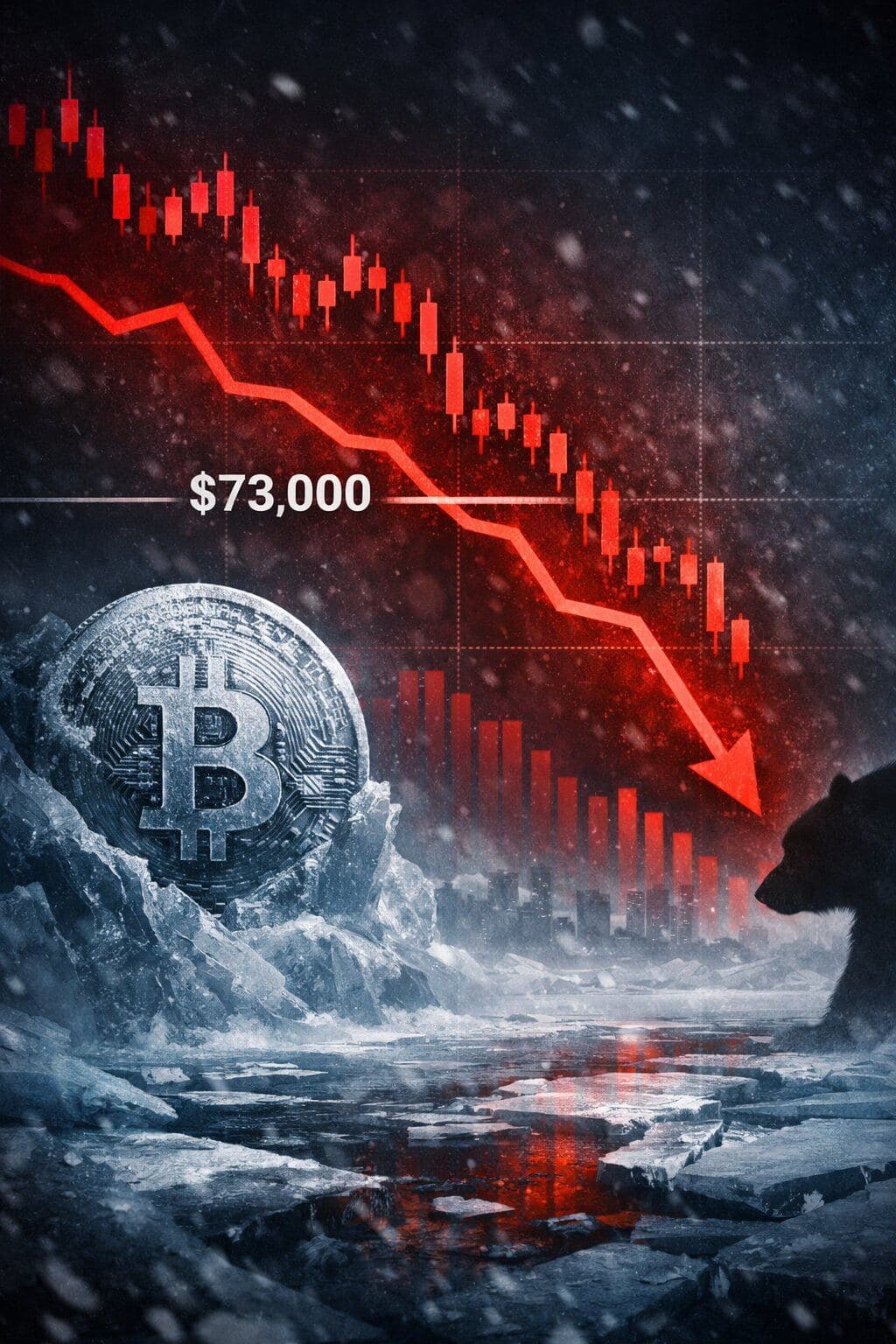
Bitcoin Crashes Below $73K, Lowest Level Since 2024 Election

Bitcoin crashed below the $73,000 level Tuesday, plunging to an intraday low of $72,884 and marking its weakest price since November 6, 2024—the day of Donald Trump's presidential election victory.
The dramatic selloff, which saw the world's largest cryptocurrency fall more than 6% intraday, extended a brutal week that has erased roughly 42% of Bitcoin's value since its October 2025 peak of $126,080. As of Wednesday morning, Bitcoin trades around $76,350, having recovered modestly from Tuesday's lows but remaining firmly in what Bitwise's Matt Hougan has called a "full-blown crypto winter."
The breakdown came as multiple headwinds converged: a sharp selloff in tech stocks, forced liquidations exceeding $5.4 billion over 72 hours, and continued institutional outflows from Bitcoin ETFs that have now reached $1.7 billion in the past week alone.
Tech Crash Amplifies Weakness
Tuesday's crypto carnage coincided with a 2% Nasdaq drop as AI stocks, software companies, and private equity firms sold off. Nvidia, Oracle, Broadcom, and Microsoft all fell 3-5%, exposing cracks in the broader risk asset rally.
Strategy (formerly MicroStrategy) fell 9% as Bitcoin briefly traded below the company's $76,000 average cost basis. Private equity giants like Blackstone and KKR dropped 6-10% after a BlackRock private debt fund revealed a 19% asset markdown, suggesting tighter liquidity than headline data indicates.
"This isn't a correction, but a full-blown crypto winter," declared Bitwise's Matt Hougan Tuesday, crystallizing fears of a prolonged downturn rather than temporary dip.
$5.4B Liquidation Cascade
The crash triggered over $5.4 billion in liquidations across 72 hours, with $4.9 billion from long positions. Bitcoin accounted for $1.88 billion in forced closures, Ethereum $1.9 billion. Saturday alone saw $2.56 billion liquidated—the 10th largest event in crypto history, per Coinglass.
Thin weekend liquidity amplified the cascade: as prices fell, overleveraged traders hit margin calls and were forced to sell, driving prices lower and triggering additional liquidations in a vicious feedback loop. Following analysts' predictions that the bear market may be in its final innings, the breakdown has raised questions about whether Bitcoin can find support or faces further downside.
Options Market Signals Defensive Positioning
The options market tells a stark story of sentiment reversal. The $75,000 put option—a bet that Bitcoin will fall below that level—is now as popular as the $100,000 call option, representing a complete inversion from the post-Trump euphoria that dominated late 2024 and early 2025.
"Massive surge in put buying over the past 48 hours... right as BTC spot crashed from 88k to 75k," noted pseudonymous analyst GravitySucks in an X post tracking the shift.
Significant open interest has also accumulated in puts at $70,000, $80,000, and $85,000 strikes, while higher-strike calls—except for the $100,000 level—lack similar activity. The pattern suggests traders are bracing for further downside rather than anticipating a swift recovery.
Jake Ostrovskis, head of OTC trading at Wintermute, noted that heavy demand for near-term downside protection has distorted the options market, pushing short-dated volatility higher than longer-dated contracts in a condition known as backwardation. The absence of demand for upside exposure mirrors conditions seen in April 2025, when Bitcoin last tested similar support levels.
ETF Outflows Accelerate
Institutional appetite for Bitcoin continues to wane, with spot Bitcoin ETFs recording $1.7 billion in outflows last week—the second consecutive week of redemptions. Year-to-date outflows now total $1 billion, representing what CoinShares head of research James Butterfill called "a marked deterioration in investor sentiment towards the asset class."
According to earlier analysis from Compass Point, Bitcoin ETFs have shed $3 billion since January 15, leaving over 50% of ETF holders underwater on their investments. The average cost basis for ETF investors sits around $81,000-$83,000, meaning Tuesday's crash to $72,884 put many institutional buyers in deep red.
This dynamic creates a potential ceiling on recovery attempts. As Bitcoin approaches the $80,000 level, underwater investors may view it as an opportunity to exit at reduced losses, generating selling pressure that could cap upside moves for weeks or months to come.
Where Bitcoin Goes From Here
Bitcoin now trades in a critical zone. Tuesday's low of $72,884 tested the March 2024 high of $73,500, which gave way under selling pressure. Immediate support sits at $70,000-$73,000, with resistance at $78,000 and then $80,000-$81,000 where underwater ETF holders may exit.
Compass Point's base case sees Bitcoin bottoming between $60,000-$68,000, with $65,000 as their central estimate. However, John Blank of Zacks warned Bitcoin could fall to $40,000 over six to eight months if conditions deteriorate.
By historical standards, the current 42% drawdown remains modest compared to 2022's 77% decline or 2018's 84% drop. Macro headwinds persist: Kevin Warsh's Fed nomination signals tighter policy, hot PPI data reduces rate cut odds, and regulatory uncertainty continues.
A Test of Conviction
Bitcoin's crash to $72,884 marks its lowest level since Trump's election—a presidency that initially sparked crypto optimism. For long-term holders, the question is whether current prices represent opportunity or deteriorating fundamentals. For traders, the focus is whether $72,000-$73,000 support holds or gives way to deeper testing.
As markets navigate their first major downturn under a supposedly friendly administration, Hougan's "full-blown crypto winter" declaration may prove prescient. Whether Bitcoin establishes a floor in the low-$70,000s or descends toward $60,000 will determine crypto's trajectory for months ahead.
Data Sources: CNBC, CoinDesk, Coinglass, CoinShares, MarketScreener
Disclaimer: This article is for informational purposes only and does not constitute financial advice. Cryptocurrency investments carry risk. Always do your own research. See our Financial Disclaimer for details.