CME Launches Cardano Futures Trading Today: What This Institutional Milestone Means for ADA Price in 2026

The Chicago Mercantile Exchange (CME) Group has officially launched regulated futures contracts for Cardano (ADA), Chainlink (LINK), and Stellar (XLM) today, February 9, 2026, representing the most significant expansion of institutional-grade cryptocurrency derivatives in history. This move effectively places Cardano alongside Bitcoin and Ethereum as a legitimized digital asset in the eyes of traditional finance.
Breaking: CME Cardano Futures Go Live
As of today, institutional investors can now trade both standard and micro-sized Cardano futures contracts on the world's leading derivatives marketplace. The standard ADA contract represents 100,000 ADA tokens, while the micro variant covers 10,000 ADA, designed to accommodate different trading profiles from hedge funds to smaller institutional desks.
According to CME Group's official announcement, these contracts will track the CME CF New York Variant Index for ADA, ensuring transparent pricing for all market participants. The launch comes after the exchange reported record-breaking cryptocurrency trading activity in 2025, with average daily volumes reaching 278,300 contracts representing $12 billion in notional value.
"Given crypto's record growth over the last year, clients are looking for trusted, regulated products to manage price risk as well as additional tools to gain exposure to this dynamic market," stated Giovanni Vicioso, CME Group's Global Head of Cryptocurrency Products.
The Institutional Significance: Why This Matters
This isn't just another exchange listing. The CME futures launch represents a watershed moment for Cardano's institutional legitimacy. The exchange now offers regulated cryptocurrency futures for Bitcoin, Ethereum, Solana, XRP, and with today's addition, Cardano, Chainlink, and Stellar.
Throughout 2025, CME Group witnessed a staggering 92% year-over-year increase in crypto trading volumes, with average daily notional values hitting $13 billion. This expansion didn't happen in a vacuum—it reflects Wall Street's growing appetite for regulated digital asset exposure beyond Bitcoin.
The introduction of both standard and micro contracts is particularly strategic. Micro contracts lower the barrier to entry for smaller institutional players while maintaining the compliance framework that pension funds, endowments, and sovereign wealth funds require. Remember, Abu Dhabi's Mubadala sovereign fund recently took a $436.9 million stake in BlackRock's Bitcoin ETP, signaling that government-backed capital is entering the crypto space through regulated channels.
For funds restricted by internal compliance policies from holding spot ADA, these futures contracts provide a crucial alternative pathway to gain exposure without custody concerns.
Current Market Context: ADA Under Pressure
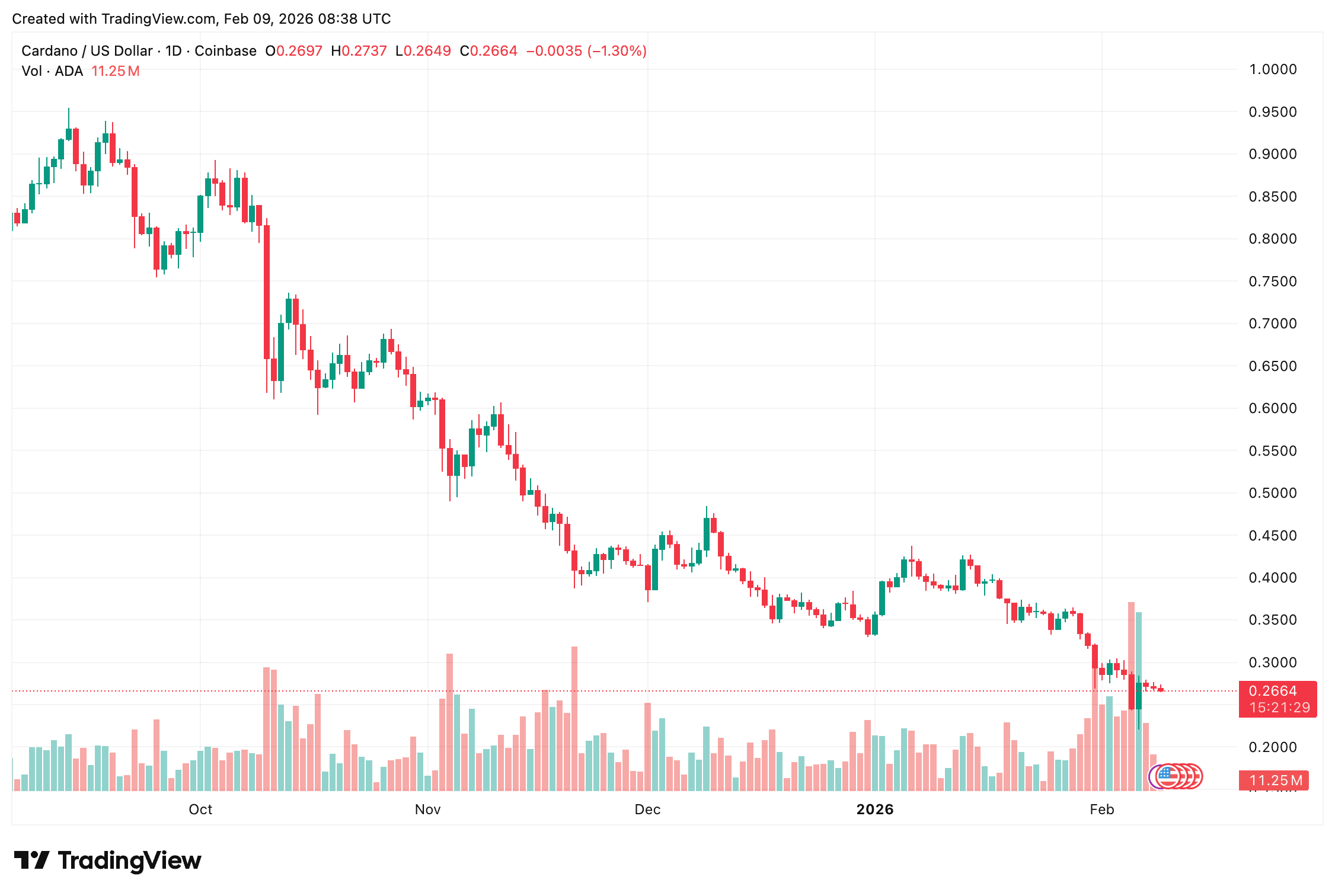
The timing of this launch comes during a challenging period for cryptocurrency markets. Cardano is currently trading around $0.26-$0.30, down significantly from previous highs, as the broader market faces substantial headwinds.
Bitcoin recently crashed below $61,000—its lowest level since November 2024—triggering over $2.56 billion in liquidations, the 10th-largest single-day event in crypto history. The entire market has been grappling with institutional outflows, with U.S. Bitcoin ETFs recording net outflows of $434 million in a single day and switching from net buyers to net sellers in 2026.
Cardano has not been immune to this sell-off. Open interest in ADA derivatives surged 5% ahead of the CME launch to approximately $586 million, but the token itself has faced bearish technical pressure, hovering near critical support at the $0.25 level.
The "Sell-the-News" Risk: Historical Patterns
CME futures launches have historically been double-edged swords for cryptocurrency prices. The pattern typically follows this trajectory:
- Rumor Phase: Prices rally as retail investors front-run anticipated institutional demand
- Launch Day: Initial volatility as traders position themselves
- Post-Launch: Often experiences a "sell-the-news" correction as momentum fades
We've seen this play out with previous CME listings. The key question becomes: Will institutional capital actually flow in, or will sophisticated traders use these instruments primarily for hedging and short positioning?
According to analysis from CCN, the launch of regulated futures often introduces powerful tools for betting against price movements, which can create downward pressure. Early market reactions showed a modest 2-3% increase in ADA's price following the announcement, but sustained gains will depend on actual capital allocation from institutional players.
Technical Outlook: What Charts Are Telling Us
From a technical standpoint, Cardano's price action heading into this launch has been concerning. The token is testing critical support around $0.39, with the Bull Bear Power (BBP) indicator dipping into negative territory, signaling fading bullish strength.
If the $0.39 support level holds, analysts suggest a potential rebound toward the 0.236 Fibonacci retracement area remains possible. However, a breakdown below this level could accelerate bearish momentum and open the door to further downside.
Compass Point analysts recently noted that the broader crypto market may be in the "final innings" of the current bear market, with Bitcoin likely to find a floor between $60,000 and $68,000. If this thesis holds, altcoins like Cardano could benefit from renewed risk appetite in the coming months.
CME's 24/7 Trading Revolution
Beyond just adding new assets, CME is fundamentally changing how cryptocurrency derivatives trade. The exchange is transitioning its entire crypto product line to 24/7 trading, effectively eliminating the "weekend gap" that has long created challenges for institutional traders.
This shift is monumental. Traditional markets operate on weekday schedules, but cryptocurrency markets never sleep. By moving to continuous trading, CME is acknowledging the reality of digital asset markets and reducing the arbitrage opportunities that existed between spot and futures prices during weekend hours.
The full 24/7 implementation is scheduled for Q2 2026, with Polkadot futures also expected to join the lineup as part of this rollout.
Cardano's Fundamental Backdrop
While price action dominates headlines, it's worth noting the technical progress occurring within the Cardano ecosystem. The Midnight privacy sidechain recently achieved a significant milestone with the launch of its NIGHT token in December 2025.
The mainnet rollout follows a phased approach:
- Phase 2 (Kūkolu): Genesis block launch scheduled for Q1 2026
- Q2 2026: Enhanced decentralization features
- Q3 2026: Full cross-chain functionality implementation
Additionally, the Ouroboros Leios upgrade—designed to significantly boost network throughput through parallel block processing—is currently in the engineering phase. Following successful testnet validation, it's slated for implementation via a hard fork.
These developments suggest that while price action remains volatile, the underlying blockchain infrastructure continues to evolve and improve.
Chainlink and Stellar: The Broader Altcoin Expansion
Today's launch isn't limited to Cardano. CME is simultaneously introducing futures for Chainlink (LINK) and Stellar (XLM), representing a comprehensive expansion into the altcoin derivatives market.
Chainlink contracts will feature:
- Standard contracts: 5,000 LINK
- Micro contracts: 250 LINK
Stellar contracts will offer:
- Standard contracts: 250,000 XLM
- Micro contracts: 12,500 XLM
This trio of launches signals CME's strategic focus on capturing the "smart contract platform" and "interoperability" segments of the crypto market. Chainlink's dominance in the oracle infrastructure space and Stellar's focus on cross-border payments complement Cardano's smart contract capabilities.
What Institutional Investors Are Watching
The trading activity beginning today will provide the first concrete data on institutional appetite for altcoin exposure through regulated channels. Key metrics to monitor include:
- Open Interest Growth: How much capital actually flows into these contracts in the first weeks
- Funding Rates: Whether traders are predominantly long or short
- Spot-Futures Basis: The price difference between spot ADA and futures contracts
- Volume Distribution: Are large block trades occurring, indicating institutional participation?
Market makers and liquidity providers like Galaxy Digital stand to benefit from these new instruments. They thrive on the "basis trade"—exploiting price differences between spot and futures markets. While this spread has compressed from 25% to roughly 5% over the past two years, the introduction of more volatile assets like Cardano creates fresh arbitrage opportunities.
Regulatory Clarity as a Tailwind
The CME launch occurs against a backdrop of improving regulatory clarity in the United States. The Trump administration has taken several pro-crypto steps, including:
- Formation of an SEC Crypto Task Force
- Rescinding of Staff Accounting Bulletin 121 (SAB 121), which had hindered bank custody services
- White House appointment of David Sacks as Special Advisor for AI and Crypto
- Congressional education initiatives on digital assets
Senator Bill Hagerty introduced new stablecoin legislation, while Congress members have outlined plans for comprehensive cryptocurrency regulatory frameworks. This improved regulatory environment makes institutional participation significantly more palatable.
The Competitive Landscape: CME vs. Coinbase
While Coinbase has dominated retail cryptocurrency trading, the institutional derivatives landscape is increasingly becoming CME territory. This dynamic has forced Coinbase to adapt its strategy.
In 2025, Coinbase acquired Deribit, an options-focused exchange, and even launched traditional commodities futures for copper and platinum in early 2026 to diversify revenue streams. Despite maintaining leadership in retail volume, the "smart money" is migrating toward CME's standardized, FIXML-compliant infrastructure.
The competition reflects a broader truth: institutional capital demands the regulatory certainty, clearinghouse protections, and established compliance frameworks that CME provides.
Prediction Markets Signal Caution
It's worth noting that prediction markets are currently pricing in continued near-term weakness for cryptocurrencies. On Polymarket, contracts tied to Bitcoin's 2026 price outcomes skew toward lower levels, with traders assigning high probability to prices at or below $65,000.
This bearish sentiment extends to altcoins. With 90 of the top 100 cryptocurrencies posting losses in recent trading sessions, and crypto market sentiment dropping to multi-year lows, the environment remains challenging.
However, contrarian investors often view extreme fear as a buying opportunity. Bitcoin's entity-adjusted realized loss hit a record $3.2 billion on February 5, a capitulation event that historically precedes market bottoms.
What This Means for ADA Holders
For existing Cardano holders and prospective investors, today's CME launch presents both opportunities and risks:
Potential Upsides:
- Enhanced institutional legitimacy could attract new capital over time
- Improved price discovery through regulated futures markets
- Greater liquidity and reduced volatility as market depth increases
- Validation of Cardano's position among top-tier cryptocurrencies
Potential Risks:
- Short-term "sell-the-news" pressure as traders take profits
- Increased ability for institutions to short ADA could cap upside
- Futures markets don't require actual token purchases, limiting spot demand
- Current bearish macro environment may overshadow positive developments
The most prudent approach is recognizing that CME futures are a long-term structural positive that may not immediately translate to price appreciation. Institutional adoption tends to unfold over quarters and years, not days and weeks.
Looking Ahead: The Infrastructure Era
The CME Group's embrace of 24/7 trading for Cardano, Chainlink, and Polkadot represents confirmation that digital assets have entered what some analysts call the "crypto infrastructure era"—a shift from speculative experimentation to core financial market integration.
Digital assets are no longer peripheral to traditional finance; they're becoming integral components of the institutional derivatives market. The institutionalization of altcoins like ADA and LINK provides the market depth necessary for these projects to be viewed as legitimate technological platforms rather than speculative tokens.
As we move through 2026, expect reduced weekend volatility but increased competition for liquidity during traditional market "off-hours." The Open Interest metrics in the weeks following today's launch will be the primary indicator of whether new capital is genuinely entering the space or if existing players are simply redistributing positions across new instruments.
Final Thoughts
Today's CME futures launch for Cardano represents a significant milestone in cryptocurrency's maturation as an asset class. While short-term price action remains uncertain amid broader market turbulence, the long-term implications are substantial.
Institutional infrastructure is being built piece by piece. Regulated futures markets, spot ETFs, bank custody solutions, and sovereign wealth fund allocations are all signs that cryptocurrency is transitioning from frontier technology to established financial asset.
For Cardano specifically, gaining institutional-grade derivatives alongside Bitcoin, Ethereum, and a select group of major cryptocurrencies validates years of development work and positions ADA for sustained relevance in the evolving digital economy.
Whether this translates to immediate price gains remains to be seen. But make no mistake: Wall Street is paying attention to Cardano in a way it never has before.
The question now isn't whether institutions will participate in crypto markets, but rather how much capital they'll ultimately deploy—and which assets will capture the lion's share of that allocation.
References:
- CME Group Official Announcements
- CoinCentral Market Analysis
- Phemex Research
- CoinGape Technical Analysis
- CCN Institutional Coverage
- Compass Point Analyst Reports
- CryptoQuant Data
- VanEck Research (Matthew Sigel)
- CoinShares (James Butterfill)
Disclaimer: This article is for informational purposes only and does not constitute financial advice. Cryptocurrency investments carry risk. Always do your own research. See our Financial Disclaimer for details.