
Why Crypto Markets Are Down: Fed Meeting, Gold $5,100, and the Perfect Storm

Bitcoin falls below $88,000 as a perfect storm of macro uncertainty, safe-haven rotation, and institutional selling creates intense pressure across crypto markets.
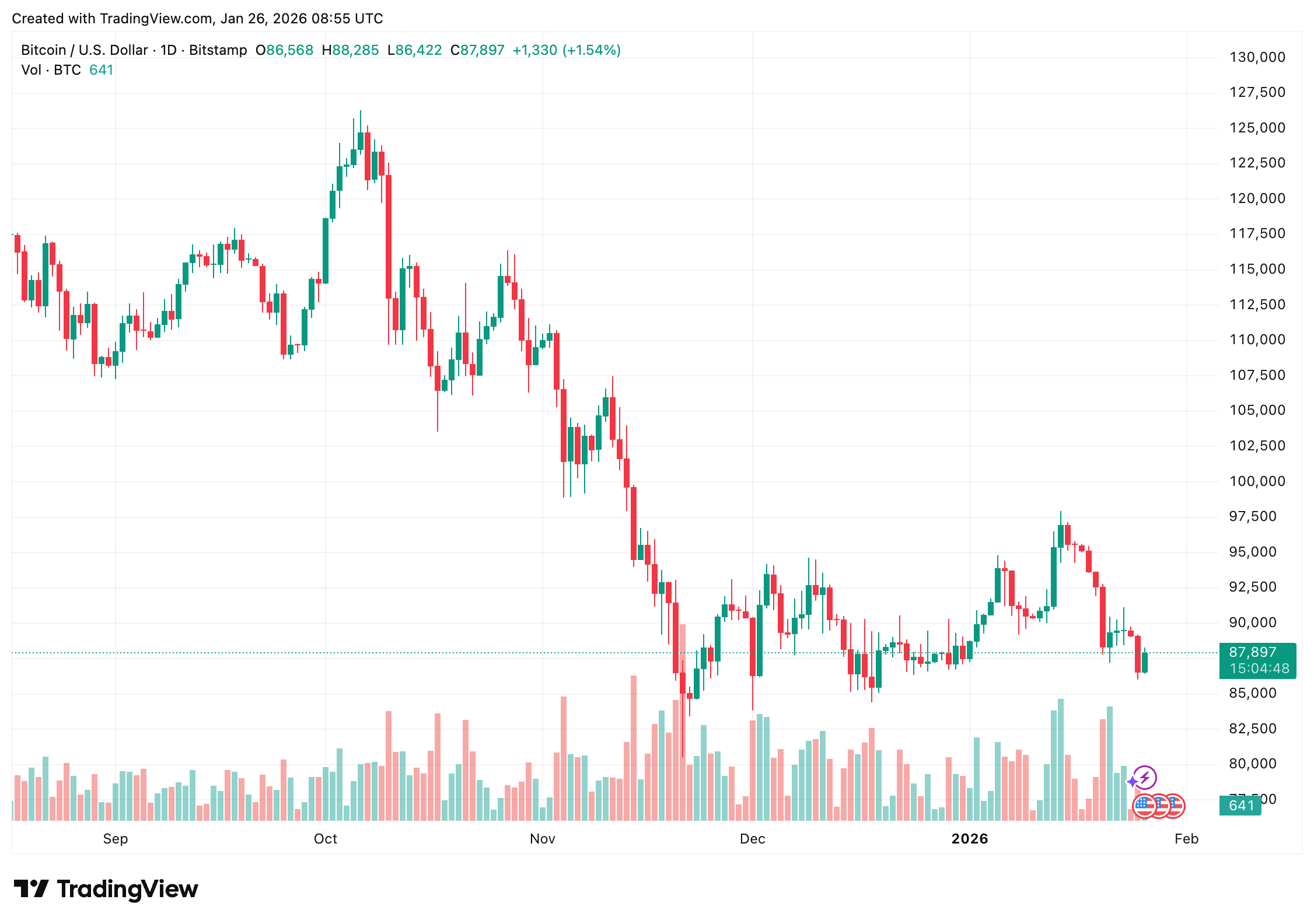
If you're wondering why your portfolio is bleeding red today, you're not alone. Bitcoin dropped to $87,800 on Monday morning, extending a brutal week that's seen the world's largest cryptocurrency lose over 30% from its October peak of $126,000.
But this isn't just another random dip. Multiple powerful forces are converging at once, creating what analysts are calling a "perfect storm" for crypto markets.
The Fed Meeting Everyone's Watching
The Federal Reserve's first policy meeting of 2026 kicks off tomorrow (January 27-28), and markets are nervous. While the Fed is widely expected to hold interest rates steady at 3.5-3.75%, it's not the decision itself that matters—it's the tone.
Three new hawkish voting members joined the FOMC this year: Beth Hammack (Cleveland Fed), Lorie Logan (Dallas Fed), and Neel Kashkari (Minneapolis Fed). Hammack has already publicly stated she opposes rate cuts until at least spring 2026, arguing that current policy is "barely restrictive, if at all."
With inflation still hovering around 3% and the Fed signaling a cautious approach, traders are pricing in the possibility of a more hawkish tone than expected. That's bad news for Bitcoin, which increasingly trades like a traditional risk asset—when stocks go down, crypto follows.
Gold Breaks $5,000 While Bitcoin Struggles

Perhaps the most painful divergence for crypto bulls: gold hit $5,100 per ounce for the first time in history this morning, while Bitcoin can't hold $90,000.
The precious metal has gained 14% year-to-date, driven by geopolitical tensions, concerns about Federal Reserve independence, and uncertainty around Trump's Greenland ambitions and threat of 100% tariffs on Canadian goods. Meanwhile, Bitcoin remains trapped in a consolidation range, down 30% from its all-time high.
The contrast is stark. Capital that might have flowed into "digital gold" is instead rushing into the real thing. Goldman Sachs recently raised its gold target to $5,400, while Standard Chartered slashed its Bitcoin forecast from $300,000 to $150,000.
Bitcoin's "safe haven" narrative—which has driven so much institutional interest—is facing its toughest test yet as precious metals dominate.
Government Shutdown Risk Adds to Uncertainty
Polymarket traders are pricing in a 76% probability of a U.S. government shutdown by the end of January. Historically, Bitcoin has sold off ahead of shutdown deadlines, only to rally once the crisis passes.
But with the Fed meeting and Big Tech earnings all happening this week, the market doesn't have the luxury of waiting. Traders are de-risking now, which means selling volatile assets like crypto first.
ETF Outflows Signal Institutional Retreat
U.S. Bitcoin spot ETFs saw $394 million in outflows on Friday alone, bringing total outflows to over $1 billion in the past two weeks. After starting the year strong with $1.2 billion in inflows during the first week of January, institutional appetite has clearly weakened.
The pattern is concerning: Bitcoin ETFs now manage around $128 billion and hold approximately 606,000 BTC (about 3% of all Bitcoin ever mined), but the "smart money" appears to be stepping back just when crypto needs it most.
Liquidations Cascade as Leverage Unwinds
The technical breakdown triggered massive liquidations. In the last 24 hours alone, $224 million in long positions were wiped out, including $68 million in Bitcoin futures and $45 million in Ethereum futures.
This creates a vicious cycle: falling prices trigger margin calls, forced selling pushes prices lower, which triggers more liquidations. It's the crypto market's version of a bank run, and it doesn't stop until all the weak hands are flushed out.
Big Tech Earnings Add to the Mix
This week also brings earnings reports from Microsoft, Meta, Tesla, and Apple—the tech giants that have driven much of the stock market's gains. With AI valuations stretched and concerns about sustainability of AI spending, any disappointment could trigger broader risk-off sentiment.
Since Bitcoin increasingly trades in sync with tech stocks, weak earnings or cautious guidance could extend crypto's pain.
What Comes Next?
The next 48 hours will be critical. Wednesday afternoon's Fed announcement at 2:00 PM EST, followed by Chair Powell's press conference at 2:30 PM, will likely set the tone for the rest of the week.
Key levels to watch:
- Support: $85,000-$86,000 (major demand zone)
- Resistance: $90,000-$92,000 (recent breakdown area)
If the Fed strikes a more dovish tone than expected—hinting at potential rate cuts later in 2026—Bitcoin could catch a bid. But if Powell reinforces the "higher for longer" narrative, the path of least resistance remains down.
For now, the market is caught between hope and fear. Long-term holders point to similar periods of consolidation before major rallies, while bears argue that the macro environment has fundamentally changed.
One thing's certain: with this many catalysts converging at once, volatility isn't going anywhere. Whether you're a trader or long-term holder, this week demands attention.
The perfect storm is here. The question is whether crypto can weather it.
References:
- Crypto Valley Journal: "Bitcoin slips below $88,000" (Jan 26, 2026)
- CNBC: "Gold surges past $5,100" (Jan 26, 2026)
- CoinDesk: "Bitcoin price news: BTC under $88,000 ahead of Fed week" (Jan 25, 2026)
- Yahoo Finance: BTC-USD price data (Jan 26, 2026)
- CoinGlass: Liquidation data
- Trading Economics: Gold price data
- Polymarket: Government shutdown probability
Disclaimer: This article is for informational purposes only and does not constitute financial advice. Cryptocurrency investments carry risk. Always do your own research. See our Financial Disclaimer for details.