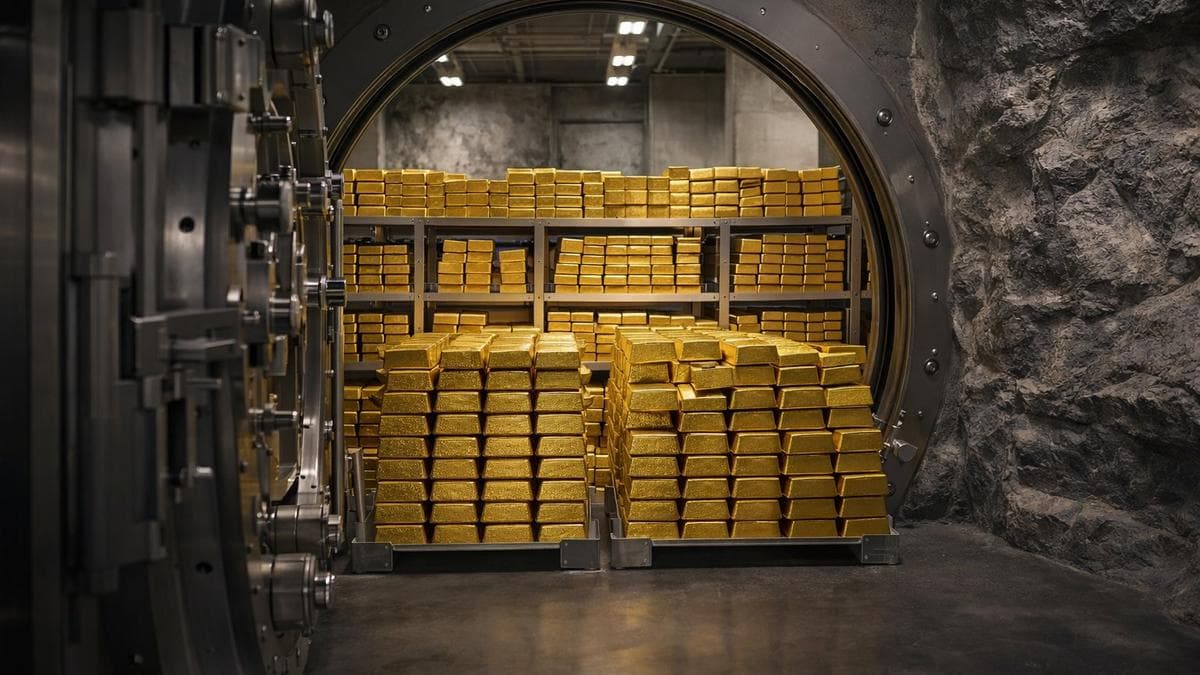
Tether Hoards $24 Billion in Gold Inside a Swiss Nuclear Bunker

While Bitcoin struggles to break $90,000, the world's largest stablecoin issuer has been quietly building something else: the biggest private gold stockpile outside of governments and central banks.
Tether now holds approximately 140 metric tons of physical gold—worth about $24 billion at current prices—secured in a former nuclear bunker in Switzerland. The company is adding 1 to 2 tons every week, spending roughly $1 billion per month on gold purchases.
To put that in perspective, Tether's gold holdings now exceed those of Greece, Qatar, and Australia combined.
"We're Becoming a Gold Central Bank"
In a recent interview with Bloomberg, Tether CEO Paolo Ardoino described the facility as heavily guarded with multiple layers of thick steel doors, evoking comparisons to locations from James Bond films.
"We are soon becoming basically one of the biggest, let's say, gold central banks in the world," Ardoino said. The company plans to maintain this aggressive buying pace for at least the next few months, with quarterly reviews determining future strategy.
Last year alone, Tether acquired over 70 metric tons of gold. In Q4 2025, the company added 27 tons—making it the largest gold buyer in the XAUUSD-linked market during that period. Only Poland declared larger volumes among central banks.
This scale of purchasing is forcing traditional bullion desks to factor a single crypto actor into their liquidity models—something that's never happened before.
Why Tether Is Buying Gold
The gold accumulation serves two strategic purposes. First, it backs Tether Gold (XAUT), the company's gold-backed stablecoin that has seen explosive growth. XAUT's market capitalization recently surpassed $2.7 billion, capturing approximately 60% of the entire gold-backed stablecoin market.
Each XAUT token represents ownership of one troy ounce of physical gold stored in Swiss vaults. The token allows crypto investors to gain exposure to gold's stability without the hassle of physical storage—and it's been growing faster than USDT itself in recent quarters.
Second, Tether is diversifying its reserves against what Ardoino calls "fiat devaluation and growing distrust in U.S. Treasury securities." While the company holds about $135 billion in U.S. Treasuries backing USDT, the gold stockpile provides a hedge against currency risk and geopolitical uncertainty.
The strategy mirrors the broader safe-haven rotation we've seen as investors flee into precious metals. Gold recently broke above $5,200 per ounce—new record highs that have made gold the star performer while Bitcoin remains range-bound.
The Swiss Bunker Strategy
Switzerland's 370,000-odd nuclear shelters are mostly Cold War relics. One of them now anchors the largest crypto company's balance sheet.
The high-security vault receives "more than a ton of gold" every week, according to Tether executives. Bloomberg reported that the logistical challenge of buying around $1 billion of physical metal monthly from Swiss refiners and global dealers is substantial—but Tether argues the payoff is resilience.
The bunker strategy isn't just about security. It's about sending a message: in a world of synthetic dollars and algorithmic stablecoins, Tether is betting that old-world metal still buys 21st-century trust.
Transparency has always been Tether's Achilles heel. By building a massive physical gold reserve that can be independently verified and audited, the company is attempting to address years of criticism about reserve adequacy.
Market Impact and Influence
Tether's gold buying is having real effects on global markets. Analysts from Jefferies Financial Group and the World Gold Council have confirmed the crypto giant as one of the drivers behind gold's historic rally.
When a single private buyer is purchasing 1-2 tons weekly—at times exceeding the acquisition rates of entire nations—it tightens available supply and can skew spreads, especially during periods when ETF demand and central bank purchases are already elevated.
Some analysts warn that this concentration risk adds a new variable on top of longstanding transparency questions around stablecoin reserves. If Tether ever needed to liquidate a significant portion of its gold holdings quickly, it could move markets.
But for now, the strategy appears to be working. Tether reported $15 billion in net profit for 2025, and holds over 96,000 BTC on its balance sheet—making it one of the largest institutional Bitcoin holders as well.
Crypto's Gold Rush
Tether isn't alone in recognizing gold's appeal. As we've covered, Hyperliquid's silver futures recently hit $1.25 billion in trading volume, signaling that crypto infrastructure is increasingly being used for traditional commodity trading.
The convergence of crypto and traditional finance is accelerating. Gold-backed stablecoins saw total market capitalization grow from $1.3 billion to over $4 billion in 2025. XAUT accounted for most of that growth, and demand continues surging as gold prices hit new records.
For crypto-native investors, Tether's bunker has become a symbol: a concrete answer to the recurring question of what, exactly, backs their digital tokens. In an era of fractional reserves and synthetic assets, physical gold stored in a Swiss nuclear bunker offers something tangible.
What It Means for USDT
Despite the gold headlines, Tether's core business remains USDT—the $186 billion stablecoin that dominates crypto markets. USDT processed $13.3 trillion in transaction volume in 2025, accounting for over 33% of all stablecoin activity globally.
The gold reserves don't directly back USDT, which remains pegged to the dollar and backed primarily by Treasury bills and cash equivalents. But they do strengthen Tether's overall balance sheet and provide additional collateral in case of extreme market stress.
As Bitcoin trades around $89,000—well below its October high of $126,000—and crypto markets search for direction, Tether is quietly positioning itself as something more than a stablecoin issuer. It's becoming a systemically important player in global gold markets.
Whether this strategy becomes a blueprint for other crypto companies remains to be seen. But one thing is clear: the world's largest stablecoin isn't just backed by promises anymore. It's backed by 140 tons of gold, sitting in a bunker built to survive nuclear war.
References
- Bloomberg
- CoinDesk
- Tether.io (Official Announcements)
- CoinGecko
- CoinMarketCap
- Investing News Network
- ForkLog
- World Gold Council
Disclaimer: This article is for informational purposes only and does not constitute financial advice. Cryptocurrency investments carry risk. Always do your own research. See our Financial Disclaimer for details.